
How I Built FeedbackThing: Reports That Point at the Button
How I built FeedbackThing, a 4 KB widget that lets a customer pin a bug report to the exact button they mean, with the selector, viewport and console errors already attached.
 Matt GardnerKept at Annapolis, Maryland
“The checkout is broken.”
That’s the whole bug report. No page, no browser, no clue which button, and a customer on the other end who has already decided your product doesn’t work. Somebody on your team is about to spend an hour finding out what they meant.
I kept getting that email across my own products. Then I started asking other founders and got the same story back every time. Feedback widgets existed. They all did the same thing, which was put up a text box and hope the customer could describe what they were looking at.
Customers aren’t technical writers. Asking them to be one is the bug.
The problem with a text box
The options I’d tried each failed in their own way.
Email support. High friction, low volume, and it usually arrives after the person has already given up and left.
Chat widgets. Great for sales. Useless for product signal, because everything lands in a Slack channel and dies there by Tuesday.
Screenshot tools. Now the customer has to install something, take a capture, attach a file, and hope they circled the right thing. Most won’t. The ones who do are your five most patient users, which is a biased sample of the people you need to hear from.
What I wanted was: click the thing, say what’s wrong, done. And the stuff I actually need (the page, the element, the viewport, the browser) captured without anybody being asked for it.
What I built
FeedbackThing is a widget you drop on a page with one script tag. About 4 KB gzipped. The customer doesn’t install anything or sign up for anything.
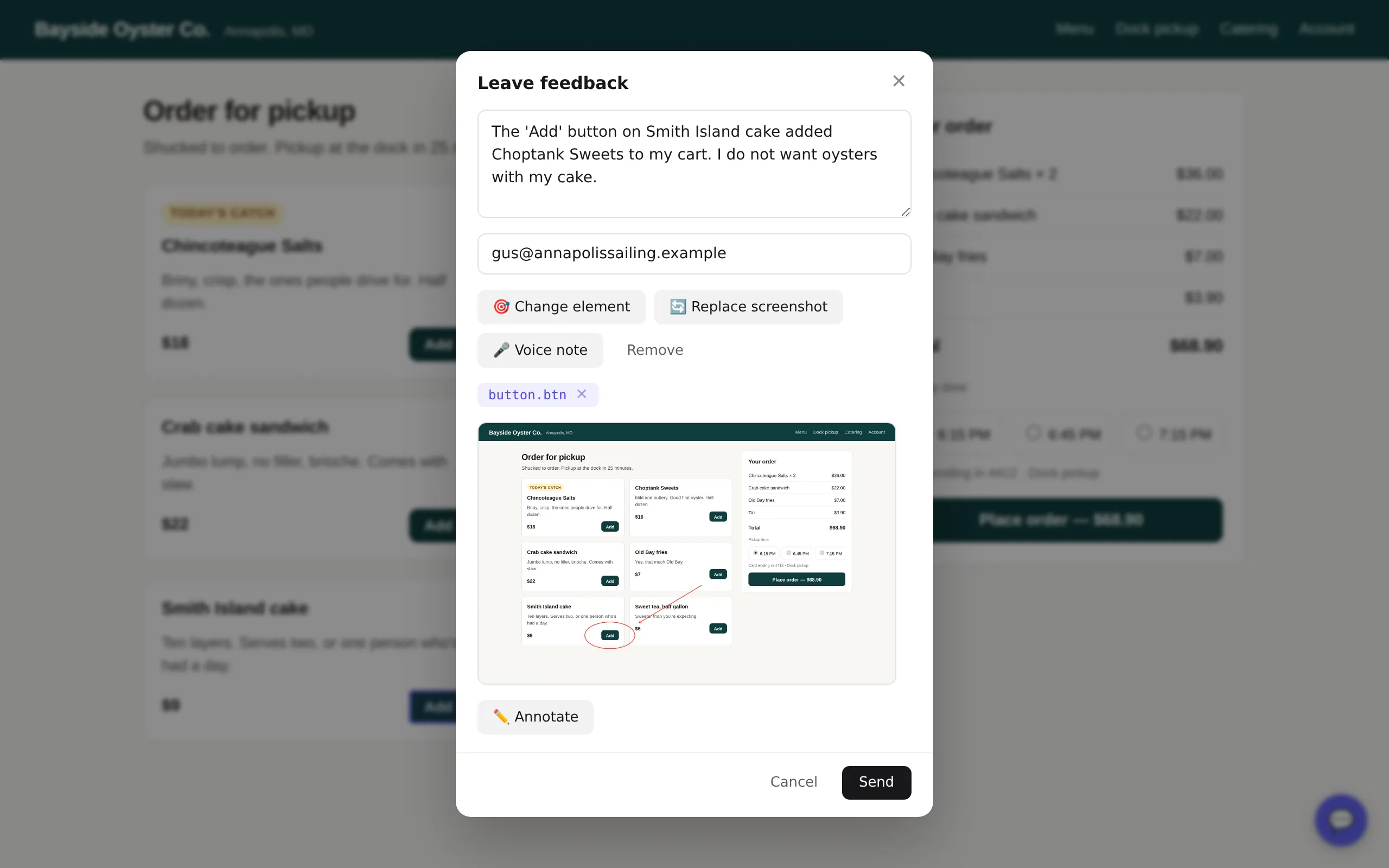
They tag the element. Someone taps the bubble, types a sentence, and hits Tag element. Whatever they hover gets an outline. They click the button they meant. That’s the whole report from their side. No form fields, because the page is the form.
They can show you. A screenshot taken from inside the page, then a circle, an arrow, a number. Or a voice note, if typing is the problem, which for a frustrated person on a phone it often is.
It arrives with everything attached. The CSS selector, the element’s inner text, the page URL, the viewport, console errors, a reply address. All the things the customer didn’t know to tell you.
It lands in one inbox per project. Who sent it, which page, where it stands. Internal notes the customer never sees, a status, and an export to Linear for the ones that turn out to be real work.
The free tier is 100 pins a month and doesn’t ask for a card, because the first thing anyone wants to know is whether their users will actually use the thing. That question should cost nothing to answer.
Two decisions I spent real time on that sound boring. First, the widget cannot shift your layout. A feedback tool that nudges your page is a feedback tool you uninstall on day two. Second, test keys: every project gets a pk_test_ key that doesn’t touch your quota, so wiring it up on staging doesn’t cost you anything or pollute the inbox you actually read.
Where it stands
It’s live, the free tier is real, and installing it takes about as long as reading this paragraph.
The useful part is what a report looks like now, and who sends one. “Something’s broken on checkout, I think?” turns into a pin on the exact field with the browser version attached, and you start hearing from people who would never have sat down to write a paragraph about it.
What this means for GTG
FeedbackThing is one of about ten products I actively build and run. Shipping it meant auth, billing, screenshot capture from inside the page, a dashboard, and an embeddable widget that has to behave itself inside somebody else’s CSS. All at once, and all of it mine to fix when it breaks.
That’s who you get when you hire Gardner Tech Group: somebody who ships every week, across a portfolio, and knows where the bodies are buried.
If you need a technical partner who can go from idea to shipped without much hand-holding, let’s talk.
-Matt
