
How I Built Pickle: A Personal CRM for Exactly One Person
How I built Pickle, a personal CRM that answers who should I talk to today, fills its own timeline from Gmail and Calendar, and hands the whole thing to any AI agent over MCP.
 Matt GardnerKept at Annapolis, Maryland
You meet someone at a conference. Good conversation, a real one, the kind you want to follow up on. You mean to write it down. You don’t.
A month later you can’t remember their last name. Six months later they signed with somebody else, and the note you were going to write is still not written.
That isn’t a discipline problem. Every personal CRM I tried asked me to be the data entry clerk for my own life, and then quietly blamed me when I stopped showing up for the job.
Why these things die
A CRM built for a sales team has a reason to be maintained: somebody’s quota depends on it and a manager reads the reports. Strip that out, hand the same tool to one person, and all that’s left is a form that nags.
Then there’s the scatter. Some of your people are in Gmail. Some are on your calendar. Some are in your phone. None of it talks to each other, so instead of one current picture of a person you have four stale partial ones, and reconciling them is a chore you will never actually do.
I had both problems. What I wanted was a tool that answered one question every morning (who should I talk to today?) without me having to feed it to get the answer.
What I built
Pickle is a personal CRM for one person, not a small team sharing one login.
It is not a sales-team tool, and I want to be specific about that, because it’s the constraint everything else came out of. No quotas. No territories. No pipeline reports for a manager who doesn’t exist. Picture a solo consultant with fifty relationships that matter, five that are overdue, and nobody on staff to notice which five.
Cadence. Every person gets a rhythm: monthly, quarterly, whatever fits them. Go quiet past it and they surface on their own, with how long it’s been. You set it once per person and Pickle does the noticing. That’s the part a spreadsheet structurally cannot do.
One page per person. Notes, calls, the dates that matter, and the meetings and threads pulled in from Gmail and Calendar without you copying anything across. The timeline fills itself.
Boards. A pipeline of people rather than companies. Every card carries a next action and a date, so nothing sits there going stale while you feel vaguely bad about it.
Pains. The problem you think someone has, and separately, what they actually said when you asked. The noes get recorded too, which turns out to be the more useful half.
Connections. Pairs of people in your network who share a mutual contact and have never met, worked out from your own threads. The introductions you could be making and didn’t know were sitting there.
Claude, and anything else that speaks MCP. Pickle ships an MCP server, so an AI agent can just use it: pull a brief on someone before the call, find the warm intro path to a stranger, log what they said, move a card across a board. It runs over stdio for Claude Desktop and Claude Code, and over HTTP so claude.ai can add Pickle as a connector.
This is the one I underestimated. Every other integration I write is me guessing in advance what you might want to do and building a button for it. MCP is handing over the whole data model and getting out of the way, so you do whatever you want with whichever model you already use. For a tool whose entire job is answering questions about people, that turned out to be the biggest feature in the list.
There’s a free plan, because nobody should have to pay up front to find out whether they’ll keep a tool like this open.
What was actually hard
The hard part is the choosing, not the syncing.
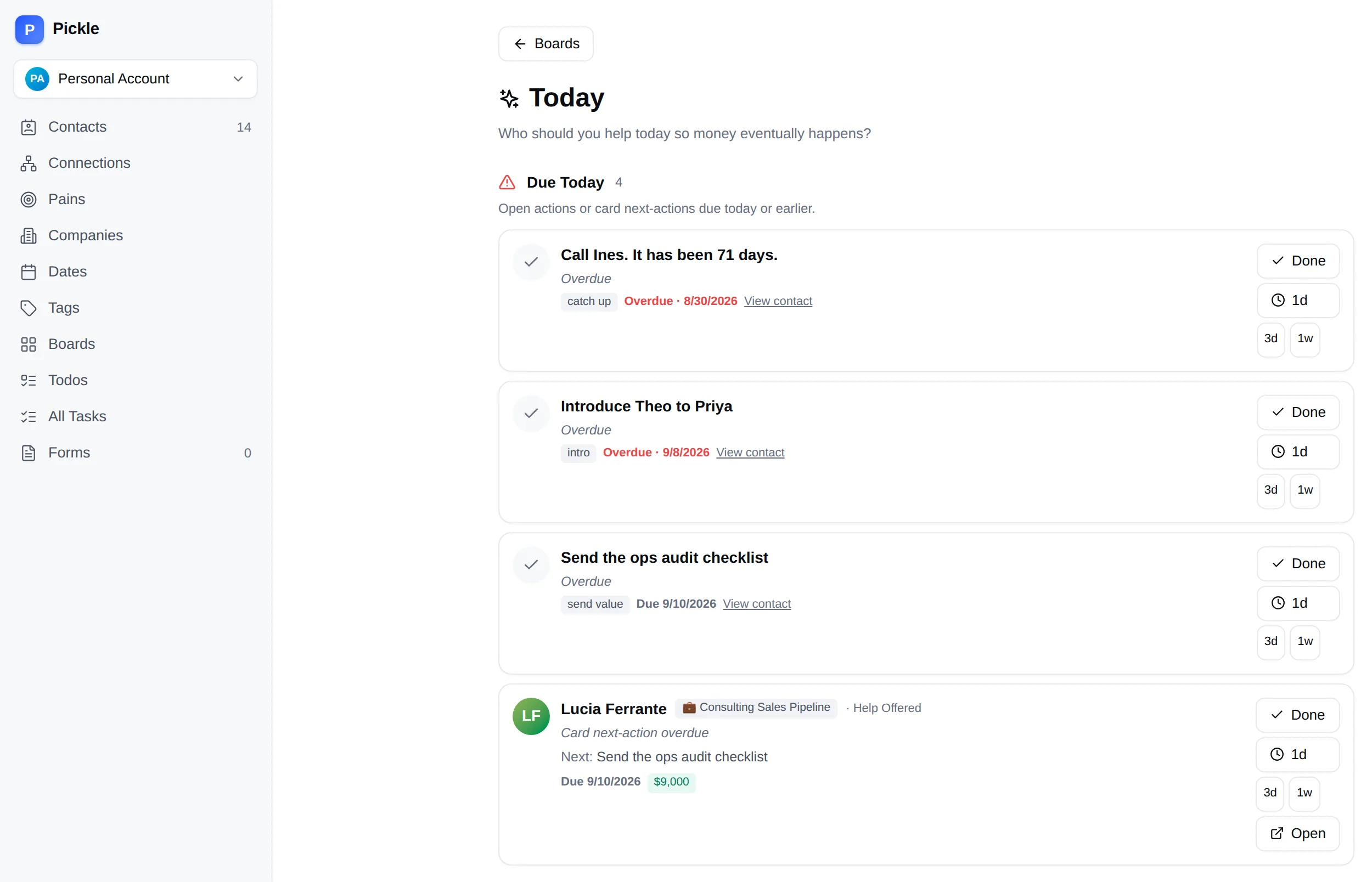
Pulling email and calendar in is a solved problem. Deciding which four people out of two hundred belong on the screen this morning is not, and getting it wrong in either direction kills the product. Too eager and it’s noise you learn to scroll past. Too quiet and you’re back to remembering things yourself, which is the thing you came here to stop doing.
So the Today page only ever answers the headline question: overdue cadences, next actions that are due, and the value you could send someone today. Everything else lives one click away. The restraint took longer to build than the features did.
Where it stands
It’s live, there’s a free plan, and the Today page is the whole pitch. If it can’t tell you who to talk to this morning, nothing else in there matters.
What this means for GTG
Most of Pickle’s difficulty lives in the data model, not the screens. And nearly every hard call was about restraint — what not to show, what not to ask the user for, what to decide on their behalf. That’s a harder discipline than adding features, and it’s the difference between software somebody opens twice and software somebody opens daily.
That’s the work Gardner Tech Group is set up for. Not an MVP, but the version that’s actually usable at the complexity the problem really has.
If you’re building anything where “it just stays current on its own” is the promise, let’s talk.
-Matt
